
ESG Management — Introduction
Ontario Line · ONxpress CJV — Exhibition to Science Centre · 15.6 km — the weekly environmental inspection, walked at Woodbine (UTS). Audience: client / prospect executive. Date: 2026-08-02.
This file is a parallel copy of
introducing-esg.html, not a generated one. The HTML deck is built bydocs/deck/build_deck.py; this markdown is maintained by hand alongside it. Change one and you must change the other, or the two will quietly disagree about what the platform does.
This deck states what works today, what does not, and what it takes to close the difference. Nothing in it is a claim we cannot show running.
Colour carries status in every diagram, and nothing else does:
| Tint | Meaning |
|---|---|
| green | Built — exists and is exercised |
| amber | Partial — exists, does not yet meet its business rule |
| red | Absent or blocked — nothing does this, or the path is severed |
1 · ESG Management
A field record system for the weekly environmental inspection — built for a wet phone, a gloved hand, and no signal.
2 · The weekly inspection is a legal record. Today it is a form.
- It is filled in from memory. A clipboard that is slower than the work gets completed at the truck at the end of the day. Everything written after that point is reconstruction, not observation — and it is the reconstruction that goes in the file.
- Four processes, one form. A non-conformance, an inspection, an audit and an incident are four different objects with four different lifecycles and four different owners. A form flattens them onto one page and closes none of them.
- The challenge comes a year later. The question is never do you have a form. It is who observed this, when, exactly where, what evidence is bound to it, and what has been changed since.
A compliance tool that is slower than the clipboard does not produce better records. It produces the same records, later, from memory.
3 · Four processes, and one place they all close
Three of them find non-conformances, and all three funnel into one ticket that outlives the walk that found it. That ticket is the only thing in the system that closes anything.
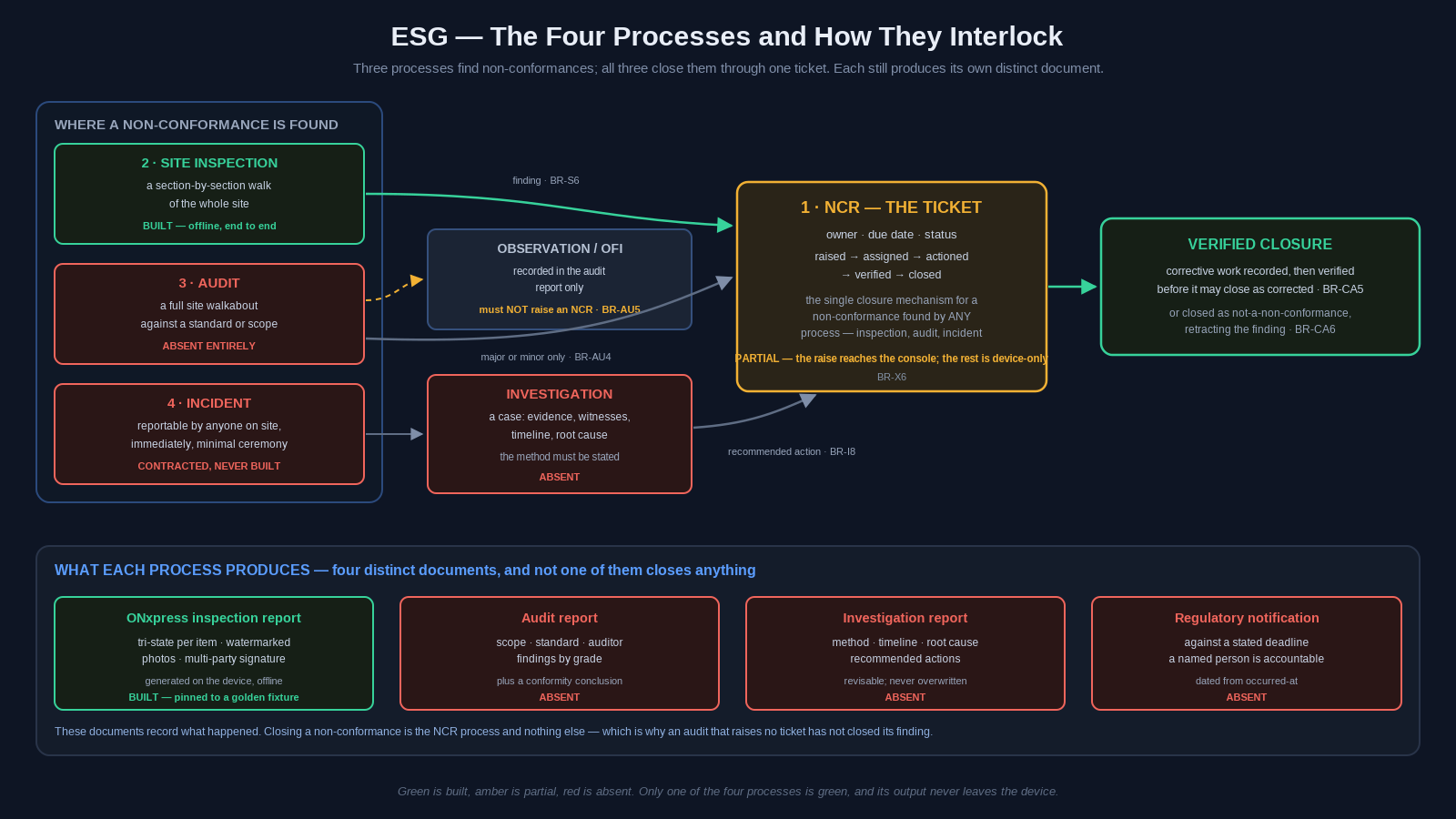
4 · Four rules the platform enforces, so nobody has to remember them
| The rule | How it is enforced | What it means for you |
|---|---|---|
| Append-only — a correction is a new record | No edit and no delete exists in any vocabulary, on the server or the device. It cannot be expressed. | Nobody can quietly revise last month's inspection. A revision is visible as a revision. |
| No invented values — unknown prints as unknown | There is no default coordinate and no default verdict to fall back to. Missing is a typed state. | A report never asserts a location, a verdict or a coverage claim that no person supplied. |
| No model in the compliance path | The compliance package forbids any AI SDK, checked by an automated guard on every build. | Where a claim is asserted, the answer is deterministic. AI assists capture; it never decides conformity. |
| Tamper-evidence | Hash-chained event store, hourly roll-up, external timestamp anchor. | Every line of a report traces to a captured event with an author, a time, and its evidence. |
These are the reason a record survives a challenge. They are properties of the store, not promises about behaviour.
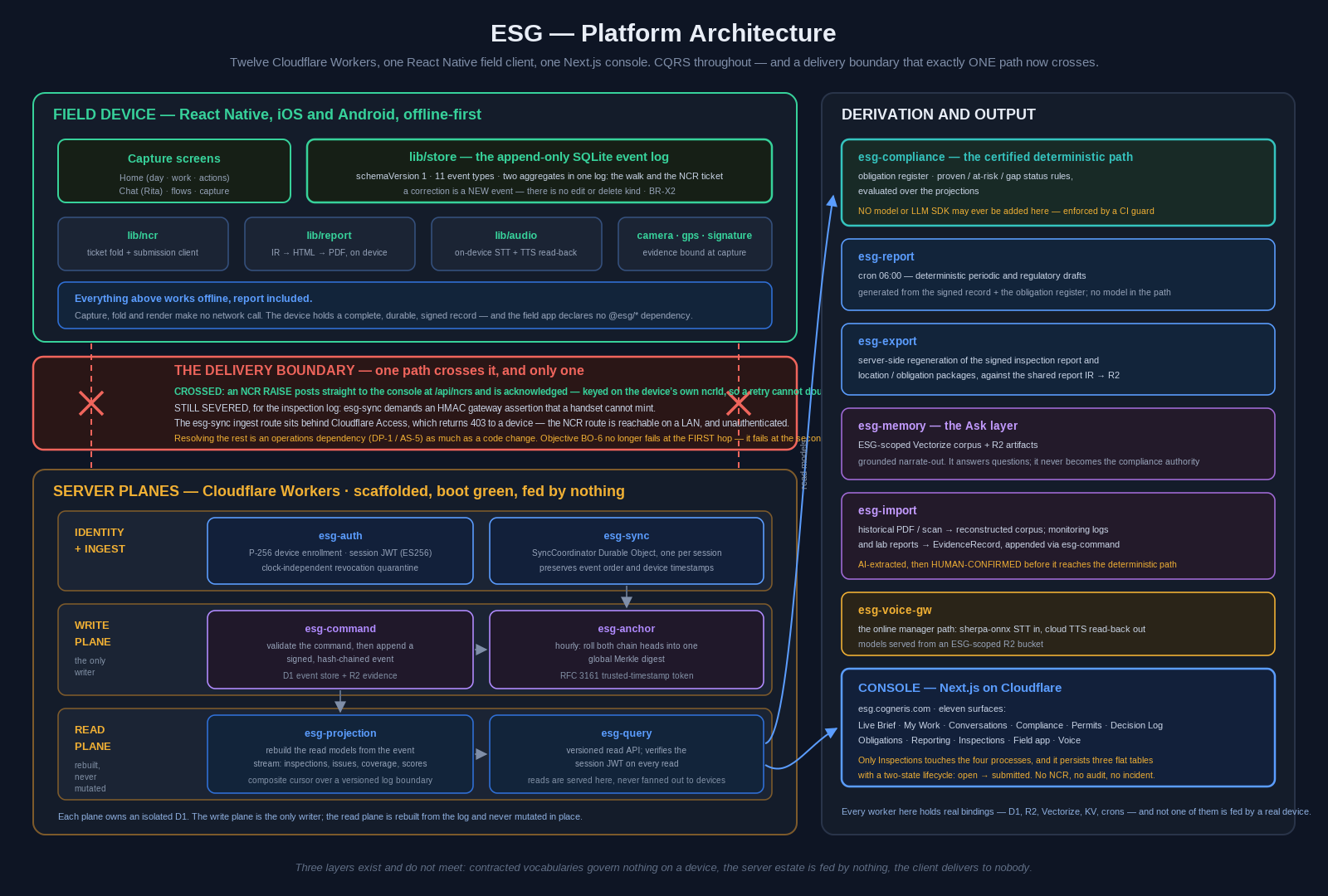
5 · How it is put together
One field client, one office console, and an event backbone that keeps the authoritative history separate from every view of it.
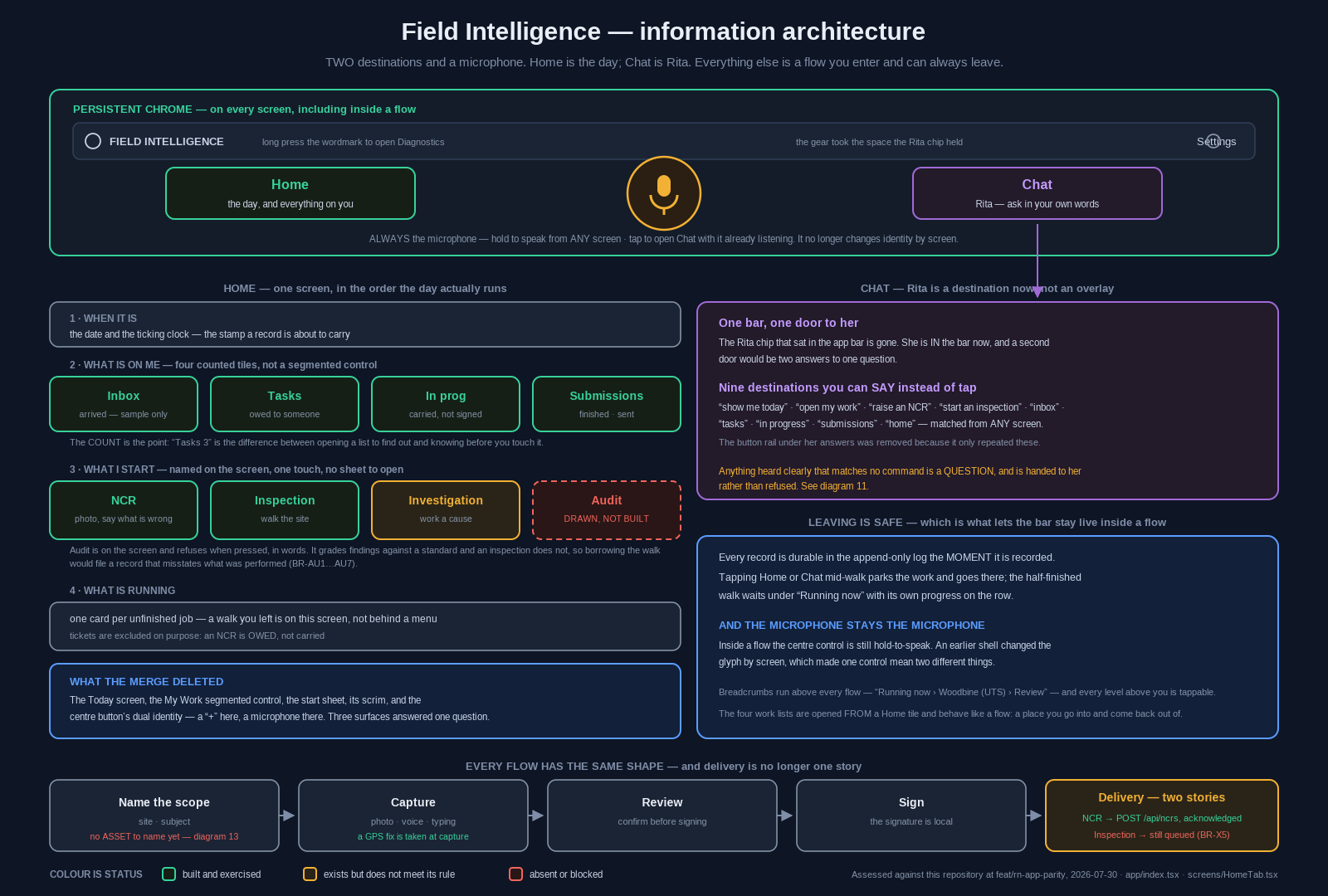
6 · The field tool: two places, three actions, one agent
Not a portal with a phone skin. Every capture is written to durable storage on the device the moment it is made — so connectivity is never a precondition, and walking away from a half-finished walk costs nothing.
7 · Fast enough to be used — without claiming anything nobody said
The adoption target. A field worker who has never seen the app completes a finding — capture, confirm, save — unassisted, in under 30 seconds, with no training. Adoption is a compliance risk rather than a preference: a tool nobody opens on site is a tool that produces records from memory, which defeats every other guarantee in this deck.
The constraint on it. No screen, default or shortcut may cause the record to assert a coverage, a verdict, a location or a conclusion that no person supplied. Where speed and honesty conflict, honesty wins — and we have already removed one screen of our own that broke this by opening an inspection pre-answered.
The second point is why the first one is credible. Any tool can be made fast by answering the form for you.
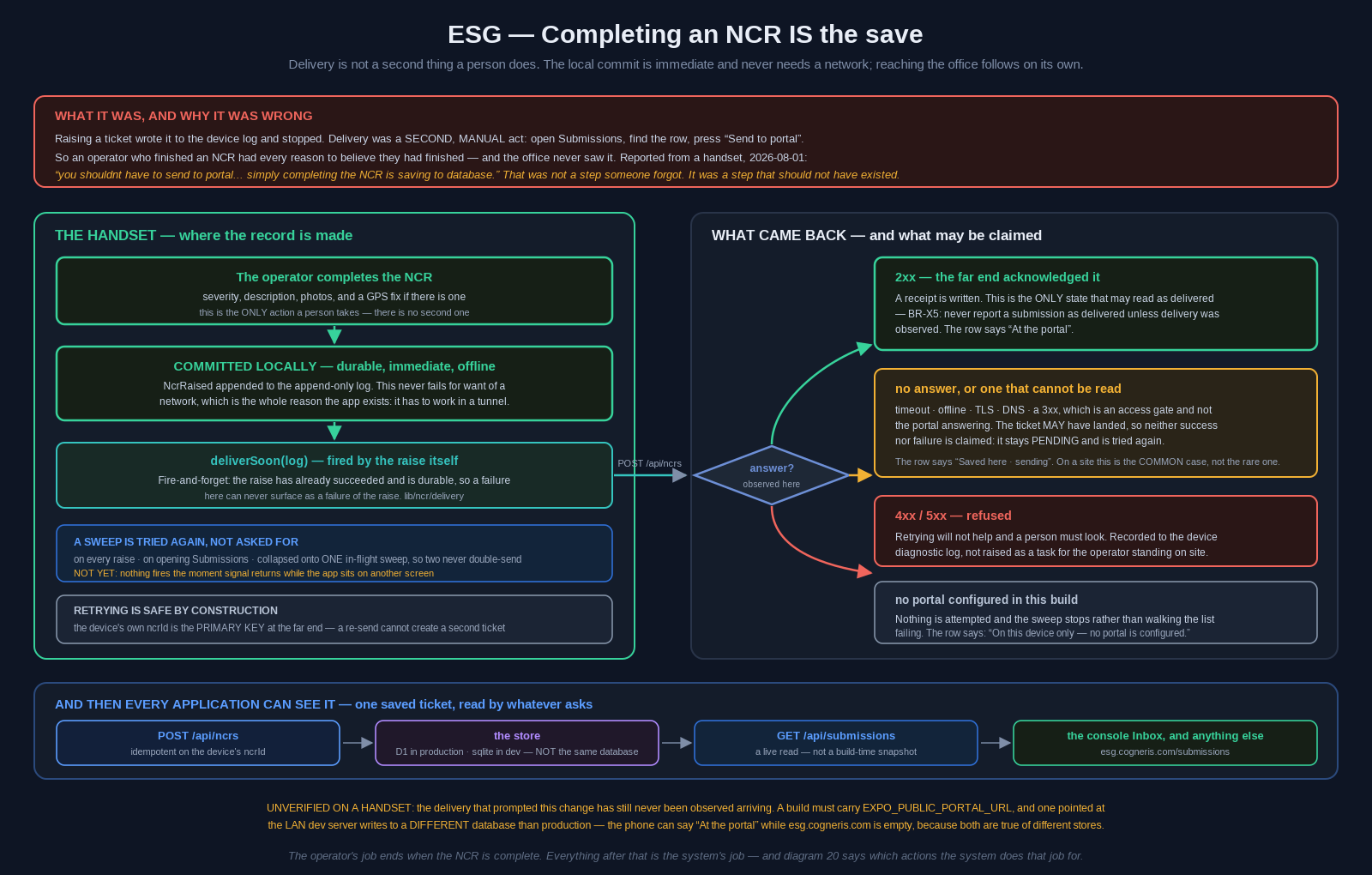
8 · The operator always knows what the office has
Saved on this device and received by the office are different facts, and the app never lets one stand in for the other. Delivery state is stated in words — never implied by an animation or a tick.
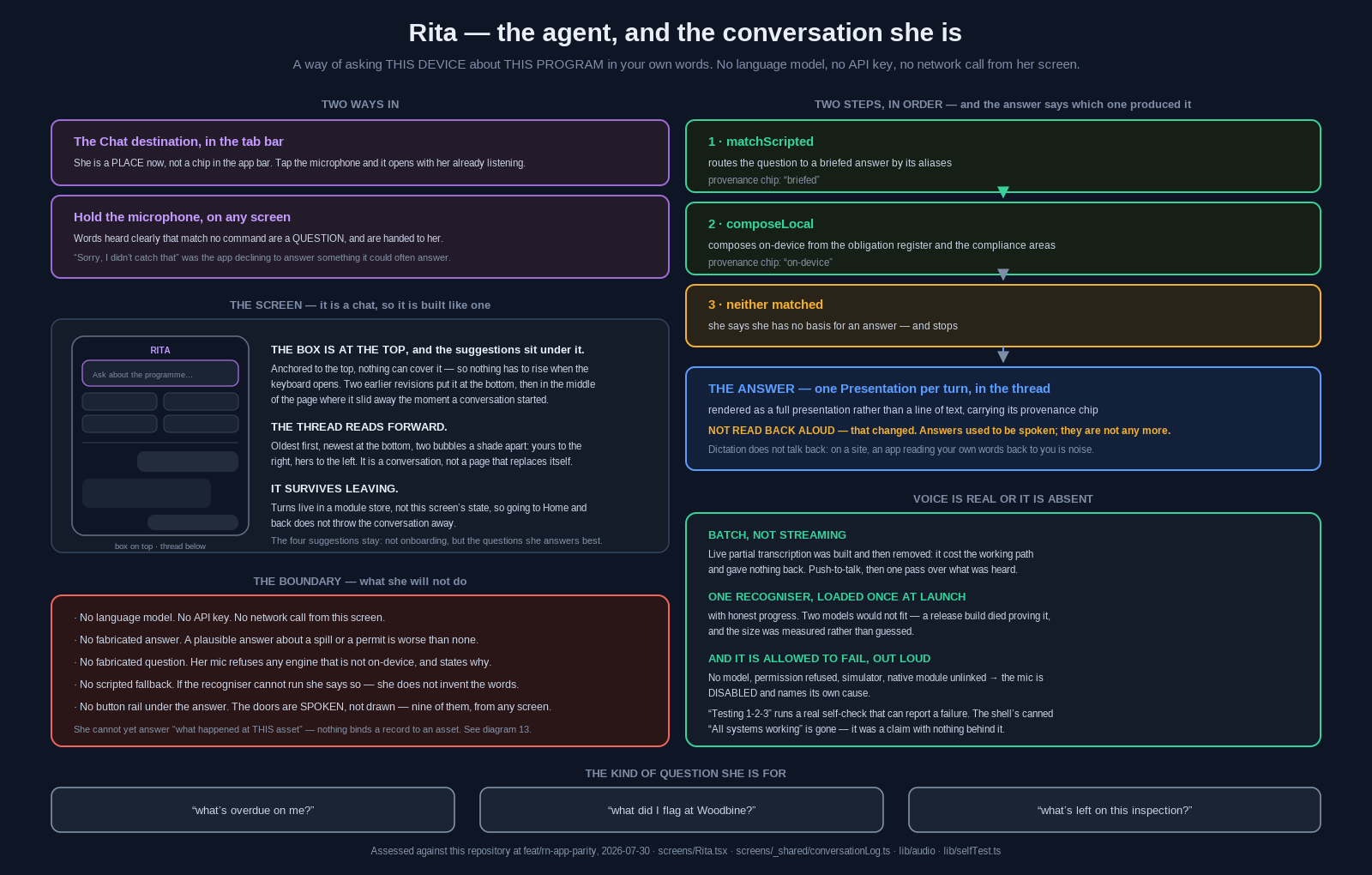
9 · Ask the device about the site, in your own words
By voice or by typing, from any screen — including mid-walk, standing in front of the thing you are asking about. There is no language model on the handset and no network call from that screen: where there is no basis for an answer, it says so and stops.
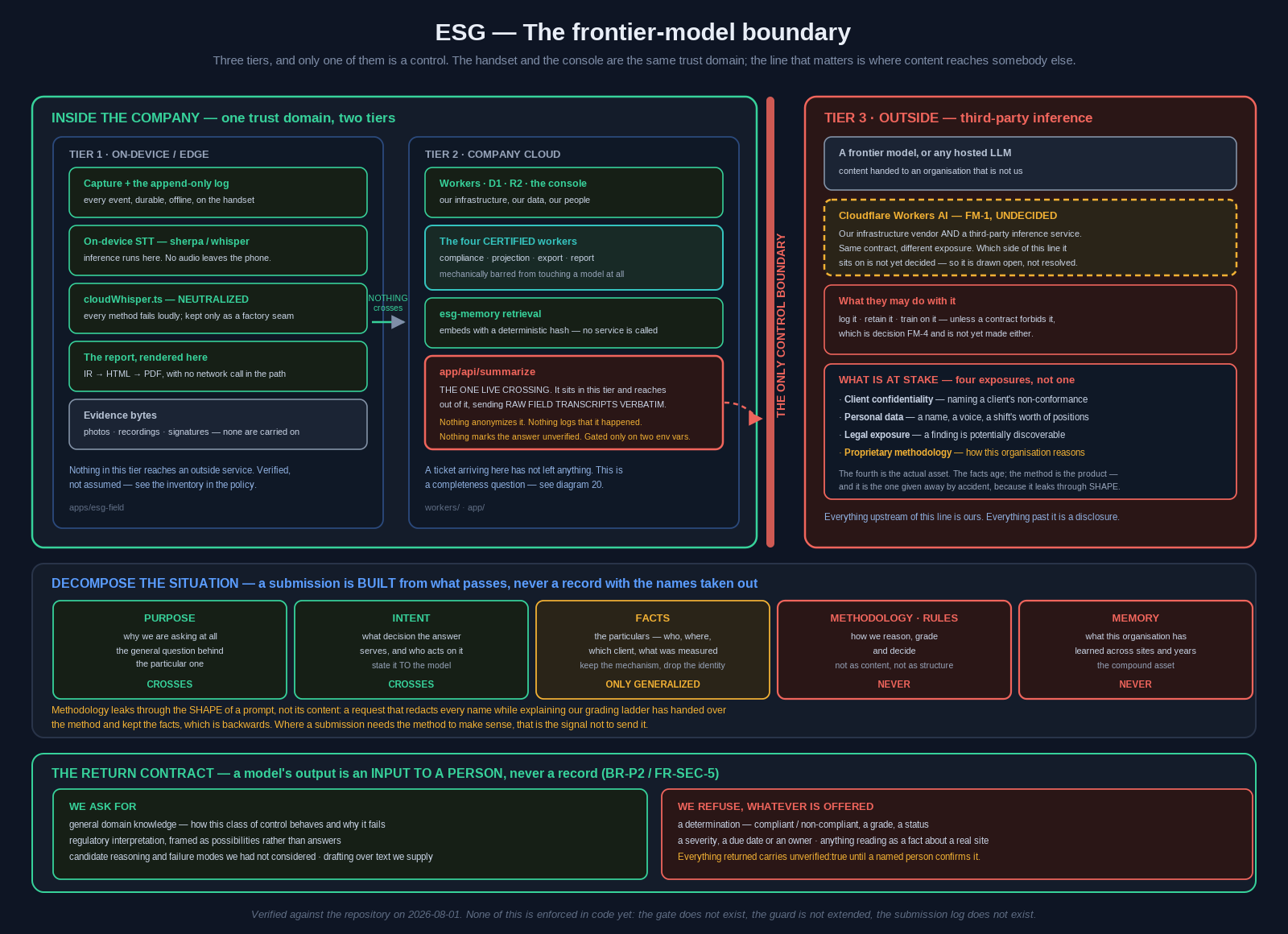
10 · Where site data goes — and where it stops
One question decides whether an ESG tool is approvable: what leaves the handset, and what reaches a third-party model. This is that boundary, drawn where it actually is rather than where it would be convenient.
11 · Your site is a place before it is a table
A register says four open non-conformances. A plan says three of them are in the same block. The Ontario Line runs 15.6 km through a century of industry — contaminated soil, a river being rebuilt, and ground holding the first Parliament of Upper Canada. On a corridor the obligation that applies is a function of where the inspector is standing, so the register is spatial before it is tabular.
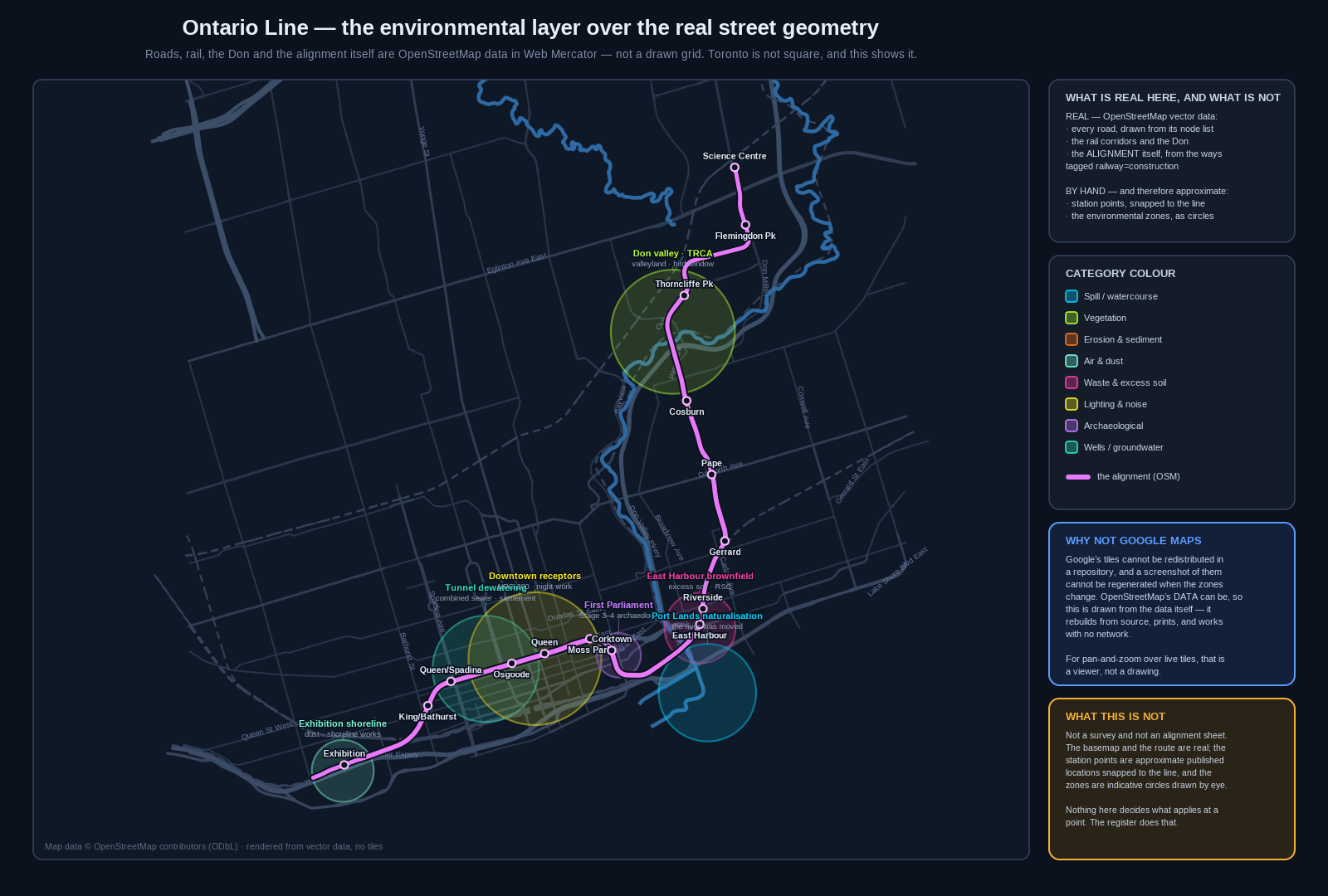
*The environmental layer over real OpenStreetMap geometry — the street you would be standing on is the street on the plan. Zones and station points are approximate and drawn by eye: nothing here decides what applies at a point. The register does that.*
12 · Where the build actually is
Eight process families. Two are built, three are partial, three do not exist.
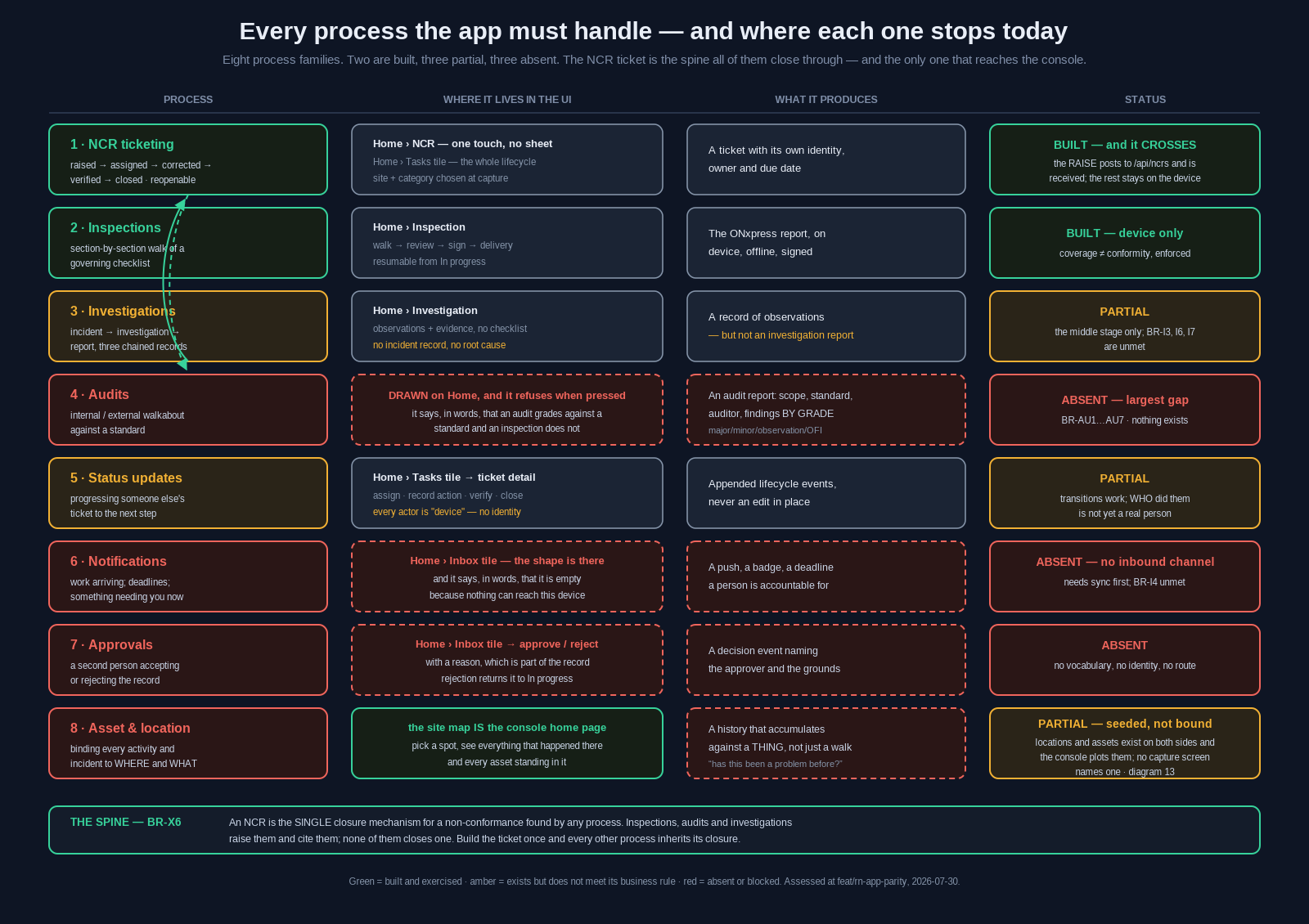
13 · The same thing, as a scorecard
| Process | Vocabulary | Capture on device | Office console | Delivery | Verdict |
|---|---|---|---|---|---|
| 1 · NCR ticket | contracted | full lifecycle | none | none | Closes out on the device; invisible to the office |
| 2 · Site inspection | contracted | capture, sign, report — offline | flat tables only | none | Captured, never delivered |
| 3 · Audit | none | none | none | none | Absent entirely — the largest gap in scope |
| 4 · Incident → investigation → report | incident only | none | none | none | Contracted, never built |
What that adds up to in your favour. The hardest part is done. A complete weekly inspection and a full non-conformance lifecycle run on a handset with no signal, and the record they produce is honest, durable and defensible.
And what it costs you today. No process in scope completes end to end, because none of it is visible from the office yet. The device now holds more good evidence than it can hand over.
14 · The one finding that matters most: captured work does not yet reach the office
Exactly one action completes the journey. Everything else is captured well and stops somewhere — refused by the receiver, or sitting in a queue that nothing drains.
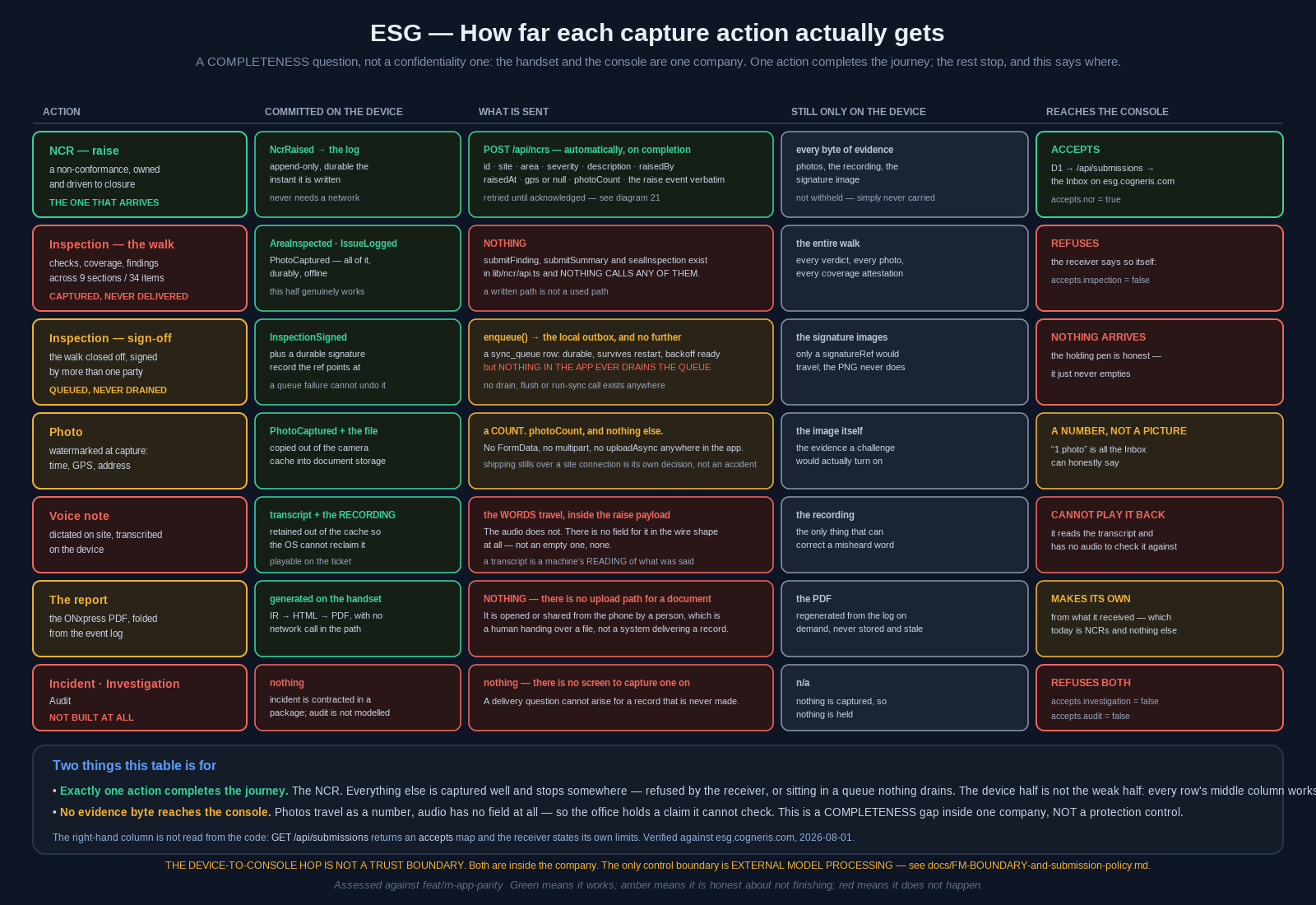
15 · Two causes, and neither of them is in the application
- Cause 1 — the door is shut at the edge. The console hostname sits behind an access gateway that adjudicates before any application code runs. A handset cannot be let in by changing the app, because the app is never reached.
- Cause 2 — there is nowhere to land. The deployed console declares no server-side storage, and eleven of the twelve backend services are built but unpublished. Opening the door alone would still not produce an ingest to reach.
Both are configuration and deployment decisions, not engineering ones — which is the good news. Closing this is days of operations work between us, not a rebuild.
16 · What it takes to finish
Ours to do
- Publish the ingest and read services, with real storage bound to them.
- Build the office surfaces for all four processes, not just inspection.
- Contract and build the audit process — vocabulary, capture and graded report.
- Prove voice capture on a real device in real site conditions. It is wired and byte-verified; nobody has yet completed a transcription on a handset, and we will not claim it until someone has.
Yours to decide
- Device access. How a handset authenticates through your access gateway. This is the single blocker on delivery.
- The audit standard. Which standard and clause set audits are graded against. Nothing can be built until it is named.
- Conversation policy. Whether asking questions of the assistant may send site data off-device, or stays on-device and bounded. We built it on-device; lifting that ceiling is a policy call, not an engineering one.
- Is a non-conformance the same object as a corrective action in your process, or its parent?
17 · What is real today
You can run this now
- A full weekly environmental inspection on a phone with no signal — captured, signed, and rendered to the pinned report format, entirely on the device.
- A non-conformance raised, assigned, corrected, verified and closed, with every transition kept as its own record and no closure reachable without verified work.
- A site plan of the program, with findings plotted where they actually happened.
You cannot do this yet
- See any of it from the office. The record is complete, durable — and on the handset.
- Run an audit, or an incident investigation.
- Rely on voice capture, until it is proven on a device.
The hard part — a record that is honest, offline and defensible — is built. What is left is a delivery boundary and two processes, and none of it is a rewrite.
Sources
Content is drawn from BRD-field-processes.md (§2 as-is, §3
objectives), ARCHITECTURE-and-process-models.md and
FIELD-INTELLIGENCE-app-rita-and-processes.md.
Diagrams are the hand-authored SVGs in diagrams/SDMS/ESG.
Three claims here were last verified on 2026-07-30, not today: that eleven of the twelve backend services are unpublished, that the access gateway blocks a device at the edge, and that no transcription has been completed on a handset. Re-check before presenting — candid framing is only worth something if the facts are current.