
Field Intelligence Agency — the app, Rita, and every process it must handle
Purpose: what the app is today, what Rita is, and what the UI becomes when it handles all seven process families — NCR ticketing, inspections, audits, investigations, status updates, notifications and approvals.
Status: draft for review. Date: 2026-07-30.
Assessed against: this repository at feat/rn-app-parity, and a real iOS build on device.
Companions: BRD-field-processes.md · FRD-field-processes.md · ARCHITECTURE-and-process-models.md
Colour carries status in every diagram and nothing else does:
| Tint | Meaning |
|---|---|
| green | Built — exists in the repository and is exercised |
| amber | Partial — exists but does not meet its business rule |
| red | Absent or blocked — nothing does this, or the path is severed |
1. What the app is
A field record-keeping tool for one operator on a site with no signal. Not a dashboard, not a portal with a phone skin. Its whole claim is that a record made on a wet phone in a hi-vis glove is durable, honest, and will stand up when someone challenges it a year later.
Three properties carry that claim, and every design decision below is downstream of them:
- Offline is the normal case, not the degraded one. Every capture writes to an append-only log on the device the moment it is made. Connectivity is never a precondition (BR-X1).
- The record never overclaims. No GPS fix invents a coordinate; no unanswered checklist item prints as compliant; nothing reports as delivered that was not observed to arrive (BR-X4, BR-S2, BR-X5).
- Corrections are new records. Nothing is edited or deleted after the fact (BR-X2).
The information architecture
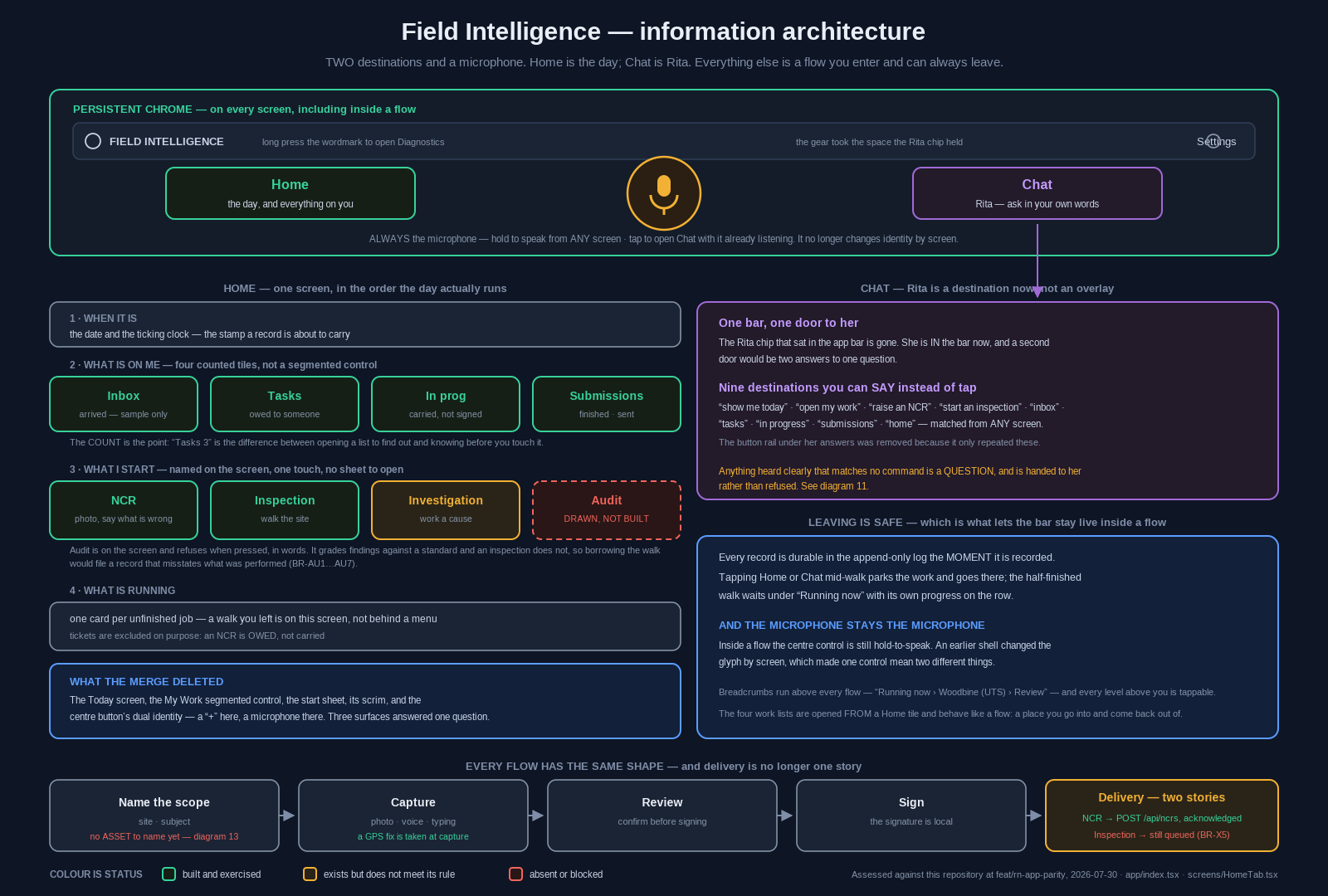
Two places, three actions, one agent.
| Today | What I am doing now. Continue the unfinished job, or start one. |
| My Work | What is on me — three segments: Inbox (what arrived) · Tasks (what is on my list) · In progress (what I am carrying) |
+ | Tap to start work; hold to speak. One control, two gestures. |
| Rita | The agent, in the app bar on every screen. |
The three segments divide by what you can do with a row, not by aggregate type. A ticket is something you owe someone and lives in Tasks; a walk is something you are halfway down and lives in In progress. An operator does not think in aggregate types.
Why the tab bar stays live inside a flow
This is the one structural decision worth defending, because the first attempt got it backwards.
The original defect: a running inspection rendered inside the tab content slot with the bar visible beneath it, and the tab handler could not clear it. Today, My Work and the centre control all highlighted on press and did nothing. The first fix hid the bar during a flow — which solved dead buttons by deleting buttons, and left one small chevron as the only exit.
The right answer is to make leaving safe. Every record is durable the instant it is made, so a walk abandoned at section three is not lost: it is a row in In progress reading 3 of 9 sections recorded, and tapping it resumes exactly there. Because leaving costs nothing, the bar can stay live and work. Nothing traps, and nothing on screen is inert.
The rule this establishes: a control that is visible must do something. If it cannot, it must not be drawn. Every screen in the expansion below is held to that.
2. What Rita is
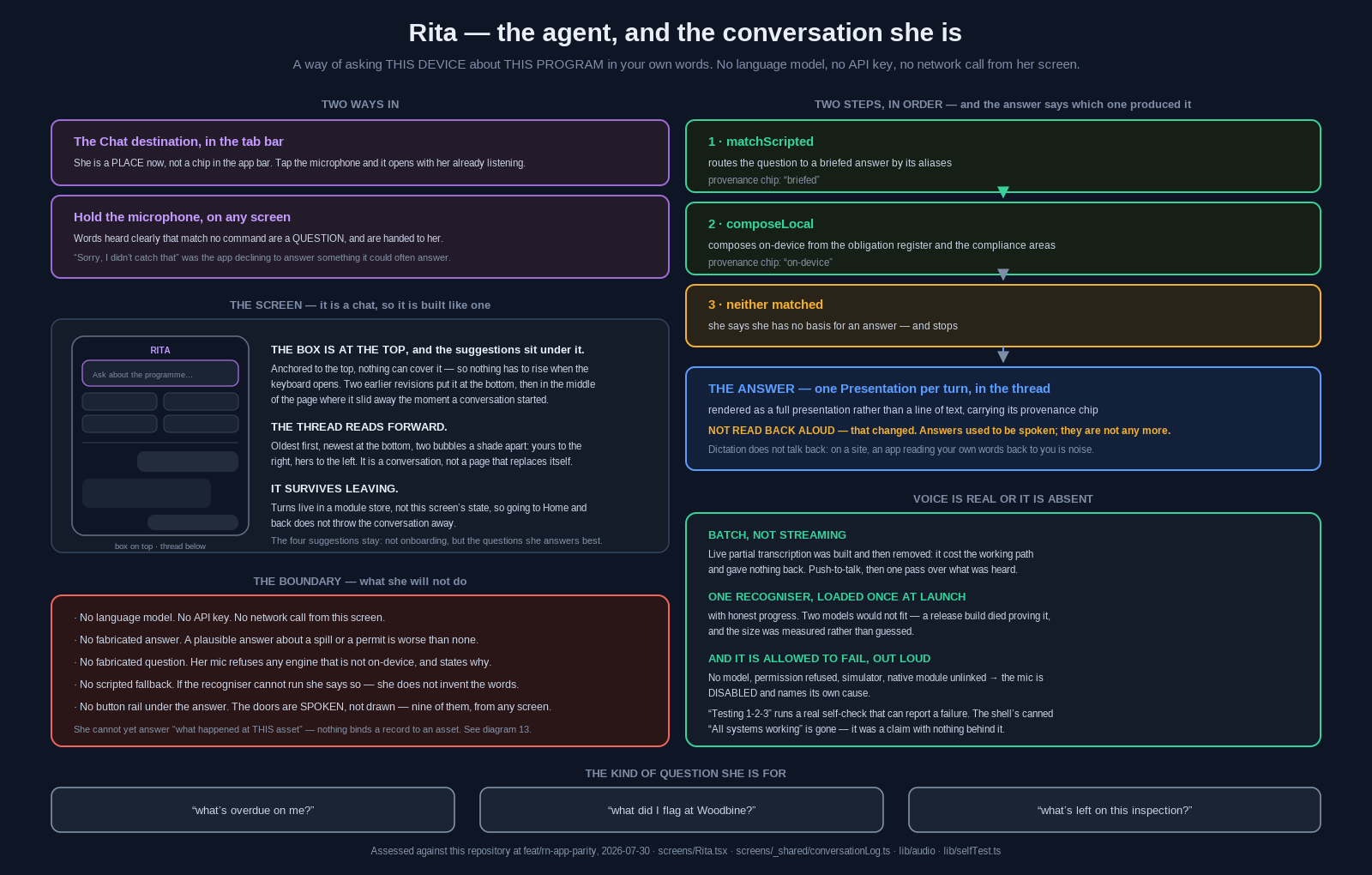
Rita is a way of asking this device about this program in your own words. Ask by voice or by typing; get an answer rendered as a page, with a chip saying where the answer came from.
Two ways to her, and the second is the one that matters:
- Her control in the app bar, on every screen — including mid-walk.
- Anything you say to the held
+that is not one of the three commands. The app used to answer an ordinary question with "Sorry, I didn't catch that", which was false: the recogniser heard perfectly well, there was simply nowhere to send a question. Now there is.
She is a layer, not a destination. Opening her does not park the walk you are in the middle of — she renders over the current screen, and closing returns to it. The commonest reason to ask is that you are standing in front of the thing you are asking about.
The boundary, stated plainly
There is no language model on this device and no network call from her screen. Rita is not a chatbot with opinions. She answers from what is briefed and what the device holds, and when neither has a basis she says so and stops. A plausible answer about a spill or a permit is worse than no answer — it is a false record that someone will act on.
Her microphone refuses any engine that is not on-device, and states why rather than falling back to a script. A fabricated question would produce a real answer to something you never asked.
Open decision for the business. Rita's ceiling is set by that boundary. Lifting it — an open-domain assistant — means sending site data off-device, which is a policy decision, not an engineering one.
scripts/guard-no-llm-in-proof-chain.mjssays the intent is to keep the proof chain model-free; whether conversation falls inside that fence is yours to decide.
3. Every process the app must handle
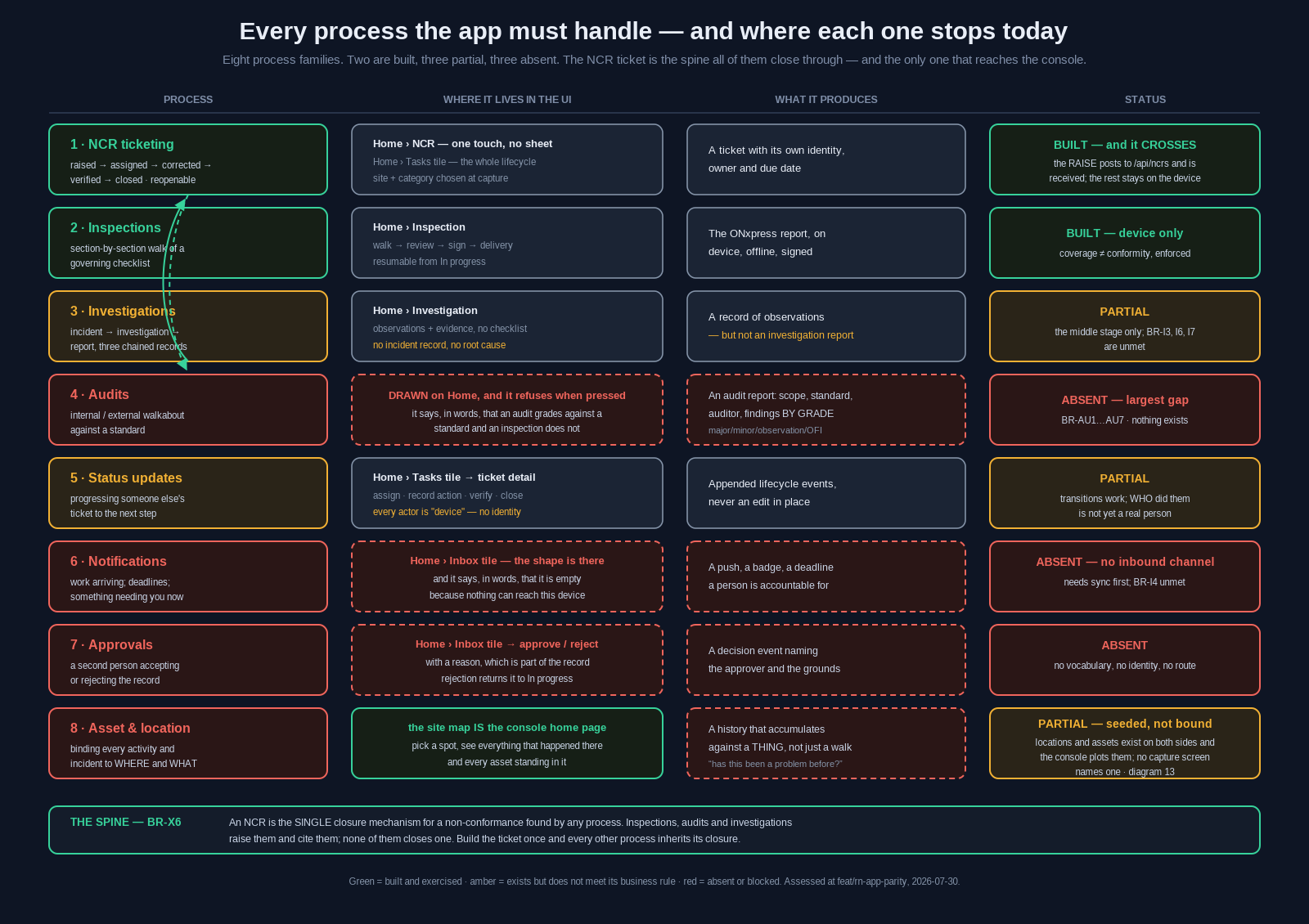
Seven process families. Three are built on the device, two are partial, two do not exist.
| # | Process | UI home | Status |
|---|---|---|---|
| 1 | NCR ticketing | + → Raise an NCR; My Work › Tasks | Built — device only |
| 2 | Inspections | + → Conduct an inspection | Built — device only |
| 3 | Investigations | + → Conduct an investigation | Partial — the middle stage only |
| 4 | Audits | a fourth + action | Absent — the largest gap |
| 5 | Status updates | My Work › Tasks → ticket detail | Partial — no real identity |
| 6 | Notifications | My Work › Inbox | Absent — no inbound channel |
| 7 | Approvals | My Work › Inbox | Absent — no vocabulary |
The spine: build the ticket once
An NCR is the single closure mechanism for a non-conformance found by any process (BR-X6). Inspections, audits and investigations raise tickets and cite them; none of them closes one. This is the highest-leverage fact in the whole design: the ticket lifecycle is already built, so every process added below inherits closure for free rather than growing its own.
What each gap actually needs
Audits (4) are structurally the walk you already have, with a different vocabulary — and the difference is the whole point, so it cannot be a checkbox on the inspection screen:
- scope is a standard or clause set, not a checklist (BR-AU1)
- the record states internal or external, and an external auditor is not an employee (BR-AU2)
- findings are graded — major / minor / observation / opportunity for improvement (BR-AU3)
- major and minor raise NCRs; observations and OFIs must not (BR-AU4, BR-AU5)
Investigations (3) have the middle stage and neither end. Needed: an incident record that anyone can create in seconds, keeping when it happened separate from when it was reported (BR-I2, BR-I3); and a conclusion that states the method used to reach root cause rather than presenting a conclusion as though evidence compelled it (BR-I7).
Status updates (5) work as transitions but every actor is the literal string "device". Approvals and accountability are meaningless until a signature names a person.
Notifications (6) and approvals (7) both wait on the same missing thing: a channel. Nothing can reach this device. The Inbox already has the right shape and says, in words, that it is empty and why — which is the honest placeholder for a feature that cannot yet exist.
4. What the UI becomes
The shell does not change shape. Two places, one +, one agent — the expansion lands as one more action, one more segment behaviour, and two new record types.
4.1 The + sheet gains a fourth action
   Raise an NCR                 photograph it, say what's wrong, raise the ticket
   Report an incident      NEW  fast, minimal, timestamped — seconds, not a form
   Conduct an inspection        the weekly checklist walk
   Conduct an audit        NEW  a walk against a standard, findings graded
   Conduct an investigation     opened FROM an incident, not from nothing
Five is the practical ceiling for a sheet you use with a thumb. If a sixth is ever needed, the sheet becomes two groups — record something and conduct a walk — rather than a longer list.
4.2 Inbox becomes real, and grows a decision
Today it honestly states it is empty. With a channel it holds three row types, each with its action on the row:
| Row | Action |
|---|---|
| Assigned to you | opens the ticket at the step that is yours |
| Needs your approval | Approve / Reject — rejection requires a reason, and the reason is part of the record |
| Due / overdue | opens the thing that is late |
An approval is a decision event naming the approver and the grounds, appended like everything else. Rejection returns the item to the originator's In progress with the reason attached — not a status flag, a sentence someone wrote.
4.3 Tasks becomes the whole ticket lifecycle
Already the right shape: yours first, then overdue, then newest, with the next step stated in words ("Corrected — needs verifying"). What it gains is who: real identity, so that assignment means something and BR-CA7 — disclosing when the same person performed and verified the work — has someone to disclose.
4.4 In progress gains audits and investigations
No structural change. An audit is a walk; an investigation is a case. Both are things you are inside and have not signed, so both are rows here, resumable exactly like an inspection.
4.5 Today becomes the day, not just the walk
Already reads the log for something to continue. With notifications it gains what is due today and what arrived while you were offline — the two questions that are genuinely about today rather than about your list.
4.6 The rules the expansion is held to
- Every visible control does something. The rule the trap taught.
- Leaving is always safe. Anything half-done is durable and waiting.
- The record never overclaims. Unanswered is not compliant; queued is not delivered; a missing fix is stated, never invented.
- Judgement is asked for where the evidence is visible — never before the operator has looked at the thing.
- Choose, don't type. Free text where a register exists spells one site four ways, and four spellings are four sites to anything that groups by site.
- One action, three inputs. Camera, voice and typing are three ways into one capture, never three destinations to find.
5. Honest status, in one place
What works on a device, offline, today: raising an NCR with photo + voice + GPS evidence; driving that ticket to closure; walking the ONxpress inspection section by section with whole-section attestation; reviewing, signing and generating the report as a PDF; resuming any of it after leaving.
What does not: anything crossing the device boundary. There is no sync, no server, no console. Delivery is honestly reported as queued, never as sent. Every actor is "device" because there is no identity yet. Audits do not exist. Notifications and approvals cannot exist until something can reach the handset.
The single unlock: identity and a channel. Six of the seven gaps above are the same missing pair, not six separate builds.